Here is a list of many frequently asked questions we are asked when our puppy families call and are learning about the breed…
What is the Australian Labradoodles’ temperament like?
How big do Australian Labradoodles get?
What is the difference between a fleece and a wool coat?
Which makes a better pet, a girl or a boy?
What is the difference between an Australian Labradoodle and other Labradoodles?
How is the Australian Labradoodle breed developed?
I have young children; is an Australian Labradoodle suitable for a young family?
How should I train my Labradoodle?
Do you recommend crate training?
How long do Labradoodles live?
How much exercise do Australian Labradoodles need?
I live in a condo; is an Australian Labradoodle suited to that?
How should I groom or bathe our labradoodle?
What is the Australian Labradoodles’ temperament like?
Australian labradoodles are characterized by their gentle good humour and easy-going nature. Some will have a playful personality, some will be more sedate, but all of them should be gentle and sweet natured. However, a labradoodle puppy is a PUPPY, after all, and will definitely require training if it is to be a pleasure to be around! Even the best natured dog can be ruined by abuse or lack of training. Australian Labradoodles are a breed that thrive with people contact and they are not suited to families that spend most of the day away from home, unless other alternatives such as doggy day care are looked into.
How big do Australian Labradoodles get?
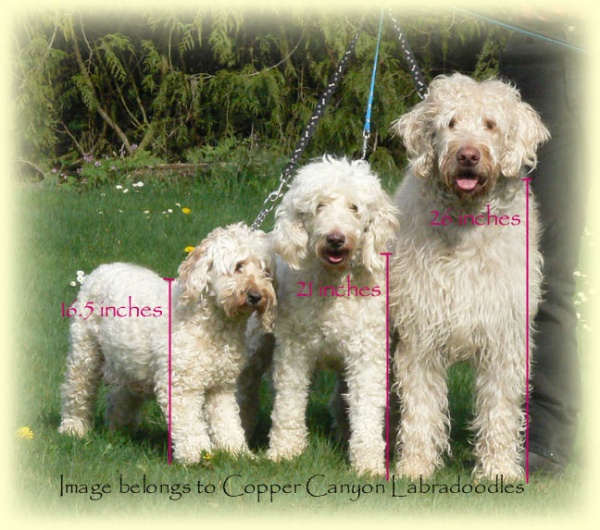
Australian Labradoodles come in three sizes. To the right is a photo of three labradoodles, showing the size difference between miniature, medium and standard.
Miniatures: 15 to17 inches, 20 to 30 pounds
Mediums: 18 to 21 inches, 30 to 45 pounds
Standards: over 21 inches, generally over 50 pounds
parti labradoodle dog, Australian labradoodle Canada, Multi gen labradoodles
What about early spay/neuter?
Early spay/neuter is one of the medical advances in the veterinary field that has had a huge impact on the number of unplanned puppies and kittens filling the animal shelters and SPCA’s. Unless a person is showing a dog in the conformation ring and/or breeding the dog, there is really no reason not to spay or neuter pet puppies. Most dogs are altered at or before six months of age, while they are still juvenile and have not had onset of adult hormones (testosterone and progesterone). Thus, whether your puppy has been altered at seven weeks or six months of age, really makes little difference to the dog’s development. But it does reduce the risk of certain cancers and it does reduce the risk of unwanted or unplanned puppies of uncertain parentage,and it guarantees that none of our puppies will ever end up in puppy mills! Here is a link to a site with more information about early spay/neuter, for those who wish more specific info on it… click here
What is the difference between a fleece and a wool coat?
The main difference between the two is the texture of the hair, not the amount of curl in the coat. While a wool coat is never straight, many curly fleece dogs can look as curly as a loose-textured wool coat, but the feel of the coat is different. Wool coats are always curly and are warmer to the touch and often slightly coarser feeling where fleece coats are soft to the touch. When testing the feel of a coat, always ‘sample’ the coat on the side rather than along the back, as the presence of kemp fibres down the spine can trick one into thinking that a fleece coat is really a wool coat!
Both coats should be non-shedding and suitable for most people with allergies, but as some people have differing degrees of allergies, it is always recommended to meet a few labradoodles in person or to work with an allergist. We are happy to provide hair and saliva samples if severe allergies are a problem, and wool coats are often recommended for severe allergies. Click on the gray wording to refer to our page with photos of various coats as puppy and adult for visuals!
Which makes a better pet, a girl or a boy?
As our Australian Labradoodles are spayed or neutered while they are still very young, the differences between the sexes is minimal. The girls do not experience hormonal cycles and the boys never develop the testosterone-driven behaviours such as marking territory, lifting legs to pee or wandering in search of girl friends. Because these differences are eliminated with spay/neutering before sexual maturation, we recommend that families base their preference on personality and activity level rather than sex. It is more important that you have a dog that suits your lifestyle, which is why we ask about your activity level (mellow, moderate, active) when you inquire about purchasing a labradoodle puppy from us.
What is the difference between an Australian Labradoodle and other kinds of Labradoodles?
There are many different kinds of labradoodles being bred to meet the demand generated by the tremendous popularity of this new breed. The Australian Labradoodle has had a lot of media attention, and has many wonderful qualities. In order to meet this demand, there are many breeders raising various types of crosses. There are two main differences between the various types of poodle/lab crosses (sometimes called American Labradoodles) and the Australian Labradoodles: predictability of coat/ body type/ temperament parent breeds infused to create the Australian Labradoodle as we know it today.
Australian Labradoodles have English and American cocker spaniel, Irish water spaniel and curly coated retriever infused into the original parent stock of lab/poodle. These other breeds have contributed towards the coat, personality and conformation of the Australian Labradoodle. The cocker spaniel contributes a beautiful domed head, stocky body and appealing face with a shorter muzzle, while the water spaniel contributed a softer, more easily trained personality to the mix. The curly coated retriever is not found a lot in the background as this infusion was not a common one, but some of the chocolate lines hark back to the curly. American Labradoodles do not have other breeds infused into them and are various percentages of lab/poodle. Many American Labradoodle breeders do not develop the breed past the first or second generations while others are working to develop beyond early generations.
F1’s are a first generation cross between a lab and poodle. F1’s will have a fair bit of variability for coat quality and energy level. Many F1’s will shed and look much like a ‘Benji dog’. Some will be easy to train, some will be boisterous and difficult to train. The temperament of the poodle and lab parent is VERY important in helping determine whether these will be nice dogs or not.
F1B’s have an F1 parent and a poodle parent; they are 3/4 poodle. They will tend to have a better coat, although a few will shed very lightly,and may have more of a poodle type build and nature. Once again, so much depends on the breeder and how well trained their eye is regarding which dogs to retain for a breeding program.
F2’s have TWO F1 parents and, while they are very valuable in a breeding program aimed at increasing the gene pool, they will often show huge variability in coat and body type within a litter. Some will have a poodle-type body, some will be stockier like a lab, some will have an F1 benji coat and some will have a curly non-shed coat.
F2B’s, F3’s, etc etc… There are many variations, but in general, the farther along the generations are, the more predictability there should be for coat type, body type and temperament.
I have young children; is an Australian Labradoodle suitable for a young family?
Yes,the Australian Labradoodle is a gentle breed that is well suited to being a family pet… AND… very young children are often rough with puppies/dogs and need constant supervision, for the safety of the puppy as well as the child/children! You are welcome to discuss with us your own family situation and we can help you decide if now is a good time to bring a new family member home or not.
How should I train my Labradoodle?
With consistent loving firmness! All labradoodles will want to know where their place is in your family and they will be happiest if you teach them how to please you. Your puppy is old enough to learn to sit, lay down,come when called and to not jump up when you get him or her home at 8weeks of age. Praise and give your puppy a treat when he does what you are looking for, and correct naughty behavior with a growl or gentle shake of the scruff. What works for the mother dog will work for us too!
We have observed the range of disciplines the mother uses with her puppies and use the same methods with our puppies and dogs. There is a current trend of “positive dog training” that only uses rewards or praise while ignoring undesirable behavior, and consistently, the families that call us with puppy training problems have been trying to raise their puppy without appropriate discipline. We believe that the same methods the mother dog uses with her puppies are the most successful and that is what we advocate. You want to reward good behavior (make it easy for them to do the behaviors you want) and discourage bad behavior (make it difficult or uncomfortable for them to do behaviours you don’t want).
Do you recommend crate training?
Crate training is optional, but we have crate trained all our dogs that live in our house. Dogs should not spend their days in a crate, but they can spend a couple hours in one while you are out doing errands! Crates become like their ‘den’ and many dogs will seek out their crate when they want quiet time or a secure place. Also, a dog that is crated cannot chew shoes or furniture while you are out!
How long do Labradoodles live?
Labradoodles are relatively long lived as a breed and an average life expectancy is between 12 and 15 years. In general, smaller dogs live longer than larger dogs, and there are many factors that affect lifespan, such as diet, exercise, genetics, accidents and injury, etc.
How much exercise do Australian Labradoodles need?
Low to moderate. Your labradoodle will need a walk once or twice a day and pee breaks at least three times a day as an adult. They enjoy walking and being out and about, but are not a high-energy dog that NEEDS to have a 3 mile run. A 30 or 40 minute stroll around the neighborhood will keep them happy. While they are well able to keep up if you go on a hike,they don’t require it.
Tip: walk your dog in the morning before you leave for work and he will spend a lot of the day resting and will be calmer and less prone to finding their own amusements! If you can’t fit the time in to do that, consider training him to go for a walk on the treadmill while you have your shower.
Some of the American Labradoodles may require more exercise than the Australian Labradoodles; there will be more variability for them with some being low to moderate and some being quite active.
I live in a condo; is an Australian Labradoodle suited to that?
Yes, a miniature or a smaller medium sized Labradoodle can do very well in a condo or apartment lifestyle. Initial potty training will be a bit more work, as you will have to make numerous trips a day to your designated potty spot though, unless you choose to continue the litter box training that we do with our Labradoodle puppies.
How should I groom our Labradoodle?
Labradoodles require occasional brushing and infrequent baths. We use a slicker brush with our dogs and it is important to brush the coat right from the skin. Most mats are formed closer to the skin, so if you just brush the surface of the hair, you will miss the parts that really need attention. Also, some coat textures may require more brushing than others, and you will get to know what your own dog needs. In general, longer coats require more brushing than shorter coats.
Frequent bathing will actually remove the natural oils from the coat, and so we most often will bath our dogs just with water unless they are really filthy from rolling in mud. Very often, if you brush them out after their coat dries, the dirt will just fall out without bathing.
The doodle clip is different than a terrier, poodle or bichon cut. The tail is left long and flowing, the coat is clipped to one length on the body and the head is trimmed tidily but not ‘pouffed’ like a poodle. We shave the bum, in between the toes on the bottom of the feet, underneath the ears and the bridge of the nose, extending to the inside corners of the eyes. I generally use a half-inch blade on the cheeks and under the chin, leaving the moustache area around the muzzle just a bit longer. Usually I scissor the moustache area , ears and the bangs/top of the head. Most people will trim them two to four times a year, generally when the brushing becomes too much of a nuisance as the coat becomes longer.
The one time you will likely want to do a short clip is when your dog loses its’ puppy coat and grows in its’ adult coat. It is the one time your pet labradoodle will actually shed a coat and it generally happens between 9 and 14 months of age.